Second order thinking
Written by Mike Barrett & Sam Bailey
01 Dec 2025

Search used to be simple. You'd type keywords, Google would show links, and your job was to win the click.
That's done.
We're now in the third year of the "Age of Answers". Your buyers increasingly get what they need inside AI tools and Google's AI Overviews without ever visiting your website.
For professional services organisations, this impacts the three things you care about most:
- Visibility - whether you show up in the conversation at all
- Positioning - how you're described when you do
- Conversion - whether high-value buyers ever make it through to you
More than half of Google searches already end without a click to any website. Multiple independent analyses put "zero-click" behaviour in the 60-65% range, and that's before Google has fully rolled out AI Overviews globally.
Here's the reality:
- Your organic search traffic has already gone down by up to 40%.
- AI referred visitors are already up to 5x more likely to convert.
Your job as a CMO or partner isn't "get more visitors". It's make sure AI can see you, understands you, and chooses you.
That's what AI readiness is actually about.
Challenge 1: Stay visible
In the Age of Answers, if you're not cited, you're invisible.
AI tools don't browse your site the way humans do. They hit search (usually Google), pull in multiple sources, synthesise an answer, and show a handful of citations (if any).
Your visibility now depends on three things:
- Machine readability - Does your content use schema markup, structured templates, and clearly defined content types? If not, AI tools will struggle to understand or reuse it.
- Answer-shaped content - FAQs, how-tos, checklists, and structured explanations. Long, dense articles are hard for AI to cite cleanly.
- Measurement beyond traffic - If you're still reporting "sessions" as a success metric, you're already behind. You need to track engagement and conversion from AI-referred visitors.
Why this matters for leaders
If your organisation loses 25-50% of organic traffic (a realistic scenario), two types of professional services organisations will emerge:
- Those who saw this coming and adapted to stay visible
- Those who noticed only when their pipeline and brand visibility had already taken the hit
This isn't an SEO task. It's a revenue protection strategy.
Challenge 2: Own the conversation
Visibility isn't enough. You also need to ask: "When AI talks about us, does it describe us accurately?"
Remember: AI doesn't quote your wording. It blends your information with thousands of external sources. If those sources are out-of-date, incomplete, irrelevant, buried on legacy pages, or written in a way AI can't easily interpret, then you may be visible but badly represented.
Common risks:
- Old content still live - preserved online forever and now being resurfaced by AI
- Ambiguous positioning - content structured around internal service lines rather than buyer needs and jobs-to-be-done
- No "single source of truth" for AI - no llms.txt or equivalent to guide how your organisation wants to be described
This isn't a technical detail. It's a brand risk.
Professional services organisations invest years building trust, credibility, and pricing power. Allowing AI to remix your history without guidance is the fastest way to dilute that.
Owning the conversation means:
- Retiring or rebuilding outdated, misleading, or legacy content
- Making audiences, journeys, and outcomes explicit (not implied)
- Providing AI systems with a deliberately structured, up-to-date understanding of your organisation
If you don't do this, AI will make up its own version of your story.
Challenge 3: Stand out
This is the part many leaders underestimate: AI has commoditised average expertise. Almost anyone can now produce "good enough" content.
The result? Generic updates blend into the noise. Practice summaries sound identical across organisations. Volume no longer drives visibility.
So what does stand out?
Trigger content
Thought leadership that creates demand, not just reacts to it. Opinions, predictions, challenges, contrasts, or new mental models. AI can remix what exists, but it can't originate your organisation's unique worldview.
Proprietary data
Research you've run, benchmarks you own, deal volumes you see, market patterns only you notice. Unique data is one of the few sources of defensible differentiation left.
Evidence of lived experience
Case studies with specifics. Named testimonials. Rich, current bios.
AI can explain the "how" but it can't replicate having actually done it.
Digital tools that help your audience make progress
Calculators, readiness assessments, benchmarking engines, decision trees.
These create value whether a buyer ever lands on your site or not.
The strategic choice is clear: continue producing random acts of content, or invest in fewer, higher-value, more original assets that AI systems cannot replicate.
Challenge 4: Shape the future
Finally, professional services leaders must acknowledge the pace of change. Search, mobile, and social were all fast. Generative AI is faster.
Algorithms, content surfaces, expectations, and behaviours now shift on a monthly basis. That makes 12-month digital plans obsolete the moment they're written.
Shaping the future means:
Running a real portfolio of digital and content experiments
Not one big AI project, but a constant stream of small bets.
Balancing "exploit" and "explore"
- Exploit - Improve what exists - structure, markup, journeys, content.
- Explore - Pilot new formats, new data opportunities, new value-adding tools.
Reviewing quarterly, not annually
Every 90 days, leaders should ask:
- How is AI currently representing us?
- Which content gets the most AI-referred conversions?
- What experiments should we double down on or kill?
The organisations that win here aren't the ones who talk about AI. They're the ones who build a repeatable way to adapt.
What you should do next
Here's what you don't need:
- More internal presentations on content creation prompts
- A giant AI strategy deck that sits untouched
- Another martech tool bought "because it has AI in it"
What you do need is a clear, objective view of where your organisation stands today across the four challenges:
- Stay visible - Can AI read and cite your content?
- Own the conversation - Is AI describing you correctly?
- Stand out - Do you have truly differentiated assets?
- Shape the future - Have you built the processes to adapt?
This shouldn't be based on assumption. You can measure it.
Put numbers against your readiness
The simplest, most strategic next step: ask your Head of Digital or Digital Marketing Manager to complete our AI Readiness Assessment.
It takes just six minutes and gives you:
- A scored view across all four challenges
- A tailored breakdown of where you're strong, and where you're exposed
- A practical playbook outlining what to prioritise in the next 90 days
From there, you can make informed decisions about investment, prioritisation, and where your digital and content strategy actually needs to evolve.
The Age of Answers is already reshaping how professional services organisations are found, understood, and chosen.
The question is no longer "Is AI relevant to us?"
It's "Are we visible, accurate, and differentiated in the places our buyers now make decisions?"
You can wait for the market to answer that for you, or you can take control now.
take our AI READINESS Assessment
Is your marketing ready for the Age of Answers?
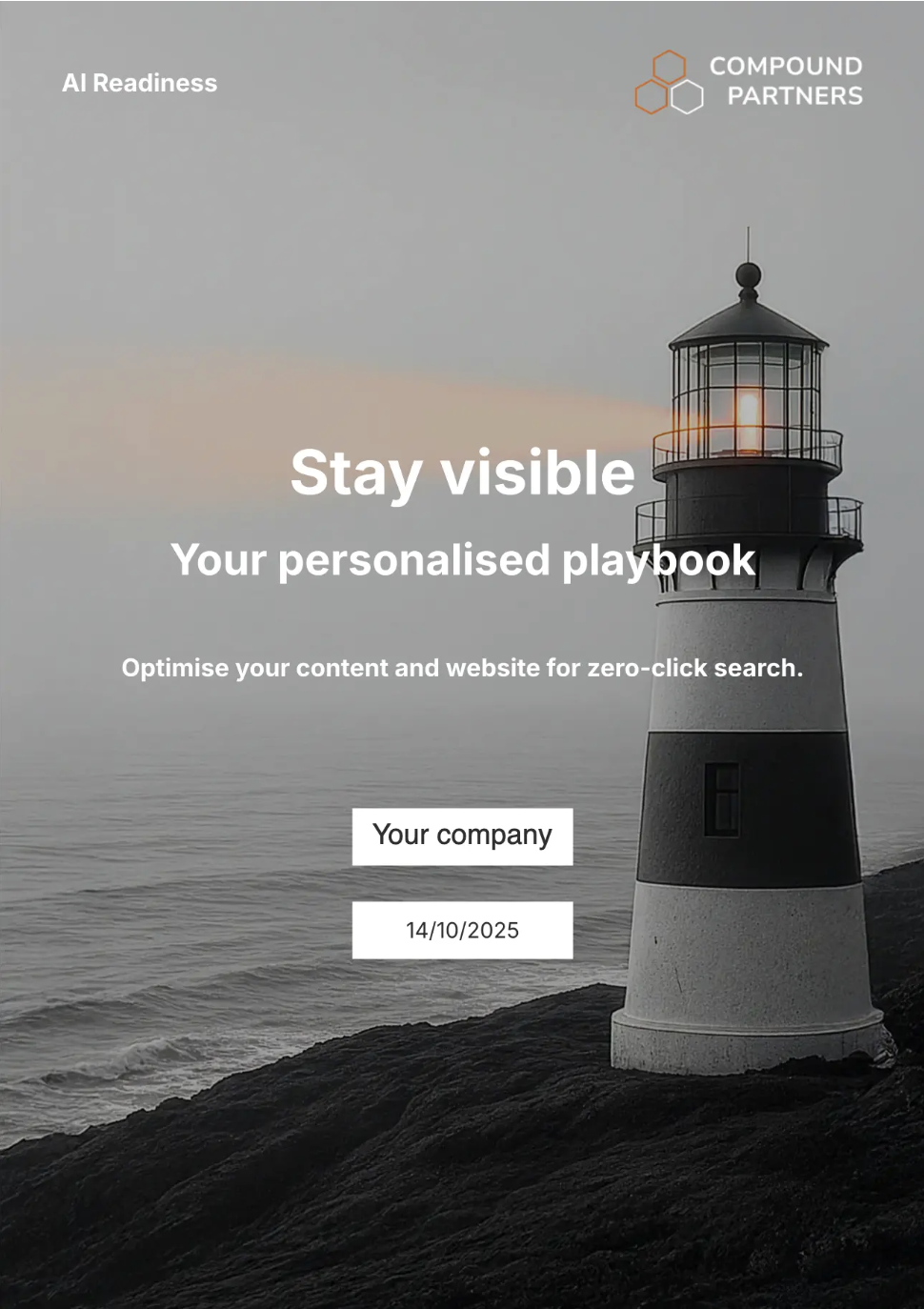
Take the AI Readiness Assessment for professional services marketers and get your personalised AI Readiness report and 13-page "Stay visible" playbook.
Answer 16 quick questions about your digital and content marketing initiatives to find out how visible your expertise is to AI, where the gaps are, and what to do next.
- It takes just 6 minutes to complete.
- It’s completely free.
Meet the team


Second order thinking
It’s not just what happens, it’s what happens next that matters.
-

Your website has three jobs now. Most professional services organisations are only doing one
Second order thinking
Over half of Google searches now end without a click. That stat should change how every professional services organisation thin…
-

Measuring brand visibility in 2026: what you’re missing and why it matters
Second order thinking
AI-driven answers are impacting your brand visibility and traditional measurement no longer shows the full impact.
-

Zero-click search is here, and it’s not going away
Second order thinking
Zero‑click search is reshaping discovery. Learn how professional services marketers can stay visible in AI answers with E‑E‑A‑T…