Second order thinking
Written by Mike Barrett & Sam Bailey
04 Jan 2026

Your brand is influencing buying decisions right now. But if you're relying on traditional metrics like search rankings, click-through rates, and website traffic, you won't see it happening.
Your prospects now encounter your expertise through AI-driven answers and enriched search results that summarise, compare, and cite sources directly. Often, those answers are enough. Research progresses or concludes before they visit your website.
This creates a dangerous blind spot. AI systems are citing your expertise when prospects research solutions. But they're also citing your competitors. If competitors appear more frequently or more prominently in those answers, they build authority you can't see. Your analytics only show declining traffic.
This isn't a technical SEO issue or an analytics gap. It's a brand visibility and reputation challenge. Authority is now established earlier in the buying cycle, mediated by systems you don't control, and invisible to the metrics you track.
How you've traditionally measured your competitive position
For most professional services organisations, visibility has been measured through a consistent set of proxies. Search rankings indicated discoverability. Clicks showed whether prospects were engaging with your thinking.
Google search performance
Measurement has typically focused on four key metrics in Google Search Console:
- Average position: where yoiur pages appear in the list of links
- Impressions: how often your pages are displayed
- Clicks: how often users click through to your site
- Click-through rate (CTR): clicks relative to impressions
On-site engagement
When prospects arrived on site, you tracked whether they engaged deeply enough to signal genuine interest:
- Time spent and pages visited
- Actions taken that signal intent
- Conversions: form submissions, tool usage, account creation
These metrics have informed budget decisions, content priorities, and competitive strategy. Rising impressions and improving rankings signalled growing discoverability. Increasing clicks and conversions confirmed that visibility was translating into engagement and pipeline opportunity.
That feedback loop is now breaking. The metrics still exist, but they no longer reflect how prospects encounter your expertise or how authority is established in your market.
Why zero-click search is breaking the feedback loop
Here's the pattern we're seeing across professional services organisations. Rankings improve. Impressions rise. But clicks through to the website are on the decline, typically by 10-40% year on year.
By traditional measures, your content strategy is working. Your visibility is growing. But fewer prospects are reaching your website.
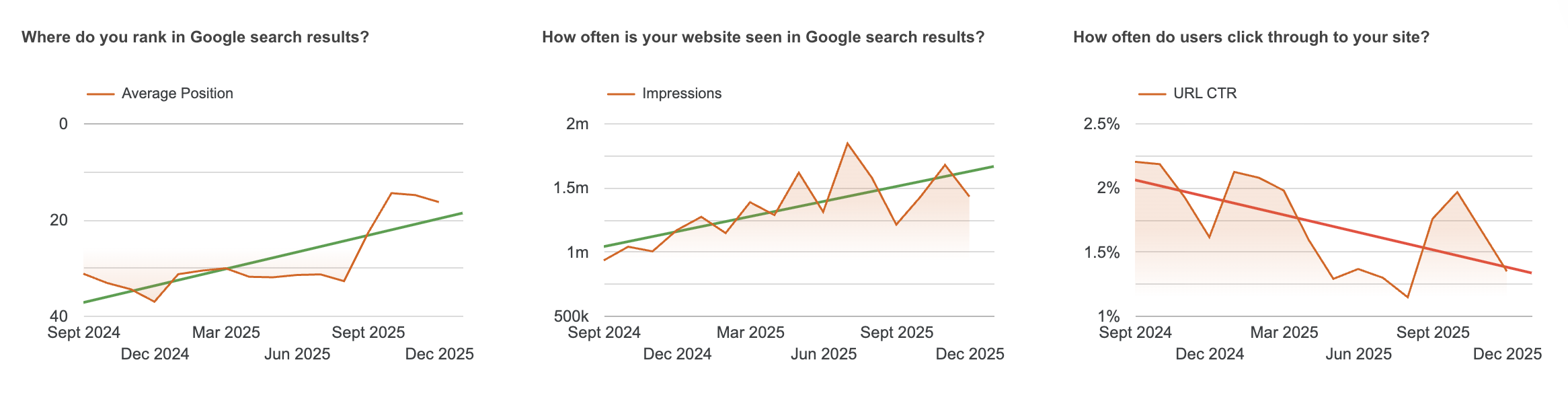
This isn't a performance issue. It's a structural shift in how prospects research and evaluate expertise:
- Prospects get answers directly in search results, complete with citations to trusted sources
- Natural language queries return synthesised responses that address their questions without requiring site visits
- The research step that used to drive traffic now happens inside the search interface
You can be doing everything the playbook says: ranking well, publishing consistently, building authority. Your metrics show growing discoverability. But traffic declines because the behaviour that generated clicks no longer exists.
The proxies that indicated competitive position (search rankings and clicks) now tell an incomplete story. Visibility is growing in traditional search results while influence is being established through AI-generated answers. Your analytics capture the former. They miss the latter entirely.
Citations: the new competitive battleground
AI-generated answers don't just provide information. They also display citations: links to the trusted sources used to construct the response.
Your expertise may be cited as a source even when prospects don't click through to your site. The citation establishes credibility and validates the answer, but removes the need to visit your website to continue research.
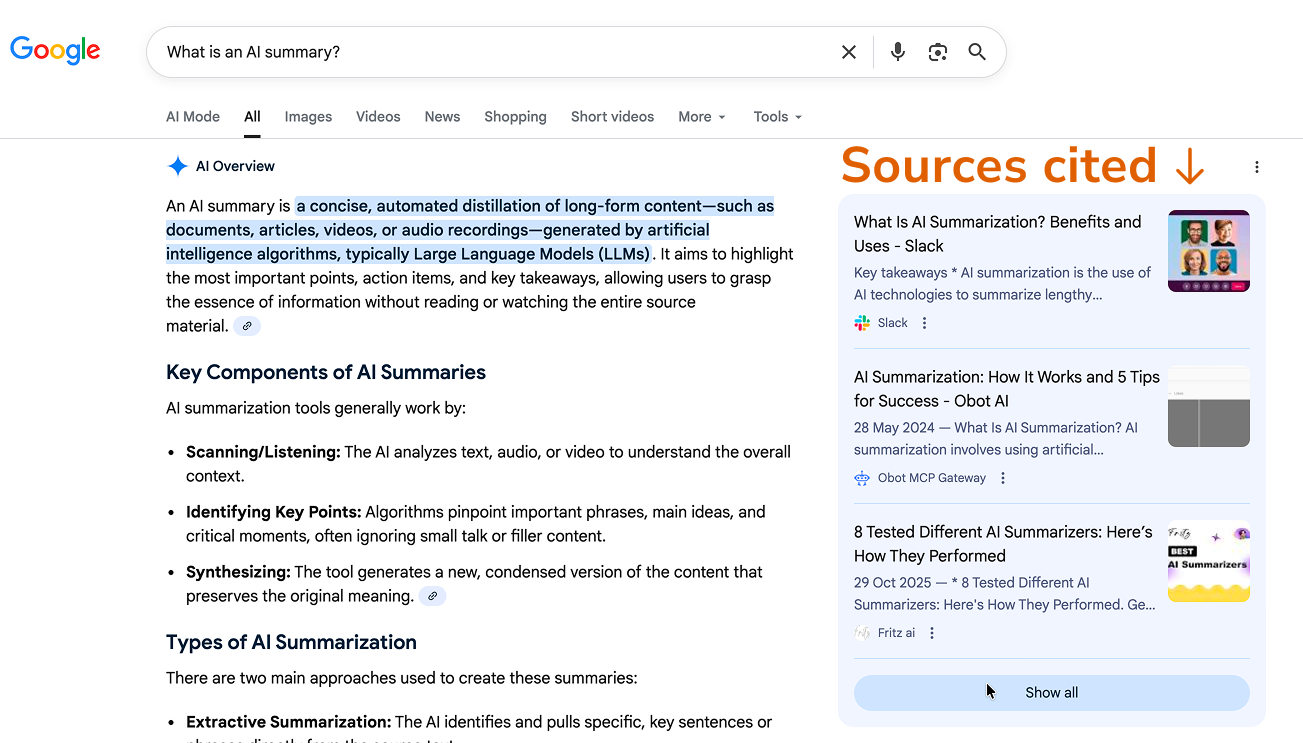
Click-through rates from citations are significantly lower than from traditional search listings. The validation has already happened. Prospects have the answer they need, attributed to sources the AI considers authoritative.
This changes the competitive dynamic. Being cited repeatedly signals authority to prospects researching your market. It positions you alongside the recognised experts in your field, even when no click follows. Absence from citations, even when your content is strong, quietly signals the opposite.
The measurement challenge
The signals you've used to allocate budget, assess competitive position, and validate strategy are becoming unreliable:
Visibility has become contextual
AI-generated answers vary based on phrasing, intent, and context. Asking the same question multiple times can produce different results, making rank-based tracking unreliable.
Attribution is increasingly opaque
When someone reads your insight in an AI overview, researches your organisation independently, and then makes contact directly, that journey rarely connects cleanly in analytics.
Citation traffic can’t yet be separated
Search platforms don’t yet clearly distinguish between traffic driven by traditional organic listings and traffic originating from AI-generated answers and citations.
Small volumes mask structural change
LLM-referred traffic remains a small proportion of overall sessions. That feels reassuring. But structural shifts always appear insignificant before they compound. By the time the volume is large enough to demand attention, competitive position has already shifted.
The LLM dimension: higher intent, lower volume
Prospects are also using LLM tools like ChatGPT, Claude, and Perplexity as alternatives to Google Search. The traffic they generate is fundamentally different from traditional organic search:
Prospects referred via LLMs arrive further along the buying journey:
They've already researched the problem, evaluated approaches, and narrowed options. These aren't casual browsers exploring a topic. They're decision-makers actively evaluating solutions, often with specific requirements in mind.
Conversion rates are significantly higher:
Even though volumes remain small, prospects referred by LLMs convert at rates up to 5x higher than cold traffic from organic search. They arrive with intent, context, and a clearer sense of what they need.
LLMs won't replace declining search traffic one-for-one. But they change the equation: fewer visits from prospects who are far more likely to engage, convert, or make contact. Being absent from LLM citations means missing the highest-value traffic you could be receiving.
What can you do while measurement catches up?
Three areas warrant immediate attention.
Ensure your expertise is discoverable by AI systems
Structured data gives AI systems the context they need to interpret and cite your content accurately. Schema markup clarifies:
- What your content addresses
- Who created it and what credentials support it
- How it relates to other content, services, and expertise in your organisation
This isn't technical optimisation. It's how authority is communicated to the systems now representing your expertise to prospects. Without this structure, your content may still be used, but it's far less likely to be cited consistently or attributed correctly.
Adapt content formats to how AI systems retrieve information
Most professional services organisations already have substantial content libraries. The challenge isn't volume, it's format. Content designed for human reading often doesn't align with how AI systems extract and present information.
Existing content can be adapted:
- Long-form articles restructured into clear how-to formats
- Thought leadership supplemented with FAQs that explicitly answer the questions prospects are asking
- Podcasts and webinars repurposed into Q&A-style content
- Case studies reorganised to surface outcomes, decisions, and proof points prominently
These formats make it easier for AI systems to identify relevant expertise and surface it in response to prospect queries.
Build feedback loops that reveal where authority is being established
Understanding which content is being cited and how prospects are responding requires new measurement approaches:
- Track LLM-referred traffic as a distinct channel rather than letting it disappear into referral or direct traffic
- Compare engagement and conversion patterns from LLM traffic against traditional organic search
- Monitor which content appears in AI citations through manual sampling, third-party tools, and pattern analysis in analytics
- Identify which topics, formats, and structures surface repeatedly
The data won't be perfect. But patterns will emerge that show where your expertise is gaining traction in AI-mediated research, and where competitors may be building citation advantages you can't yet see in traditional metrics.
The goal is to understand where authority is being established while you still have the opportunity to strengthen your position. Waiting for complete measurement means responding after competitive dynamics have already shifted.
Why does this matter in 2026?
Organic referrals will continue declining as prospects receive answers directly in search results. That traffic won't be replaced one-for-one by LLM referrals. Authority will consolidate around the organisations that AI systems cite consistently when prospects research solutions in your market.
Your competitive position is being established now through systems that cite, compare, and recommend expertise before prospects make contact. Your competitors may already be building these advantages while your analytics show only declining traffic.
The window to adapt is open, but it won't stay open indefinitely. Waiting for better measurement means responding after competitive positions have already hardened.
Your visibility in 2026 won't be defined by search rankings or traffic volume. It will be determined by whether your expertise is cited when prospects research solutions, compare options, and form shortlists. The question is whether you act while you still have authority to protect, or after your competitors have already established theirs.
Get AI-ready for 2026:
Assess the impact of AI on your marketing
Get an easily digestible board-ready snapshot of how zero-click search is impacting your marketing:
- Quantify your dependency on organic search and the impact of zero-click behaviour
- Surface the early signals from AI and LLM referrals (ChatGPT, Perplexity, and others)
- Benchmark engagement and conversion from AI visitors against your other key channels
This assessment will give you concrete, evidence-based answers and clear next steps.
Assess your AI readiness
Take our AI Readiness Assessment for professional services marketers and get your personalised AI Readiness report and 13-page "Stay visible" playbook.
Answer 16 quick questions about your digital and content marketing initiatives to find out how visible your expertise is to AI, where the gaps are, and what to do next.
- It takes just 6 minutes to complete.
- It’s completely free.
Meet the team


Second order thinking
It’s not just what happens, it’s what happens next that matters.
-

Your website has three jobs now. Most professional services organisations are only doing one
Second order thinking
Over half of Google searches now end without a click. That stat should change how every professional services organisation thin…
-

Three years in: the AI search reality professional services can't ignore
Second order thinking
By 2026, AI will answer most buyer questions without sending them to your site. Are you visible, accurate, and differentiated w…
-

Zero-click search is here, and it’s not going away
Second order thinking
Zero‑click search is reshaping discovery. Learn how professional services marketers can stay visible in AI answers with E‑E‑A‑T…